Tree Removal Service in Huntsville
Tree removal service in Huntsville and nearby towns. Controlled dismantling of hazardous, dead, or crowded trees on tight lots and red clay soil.
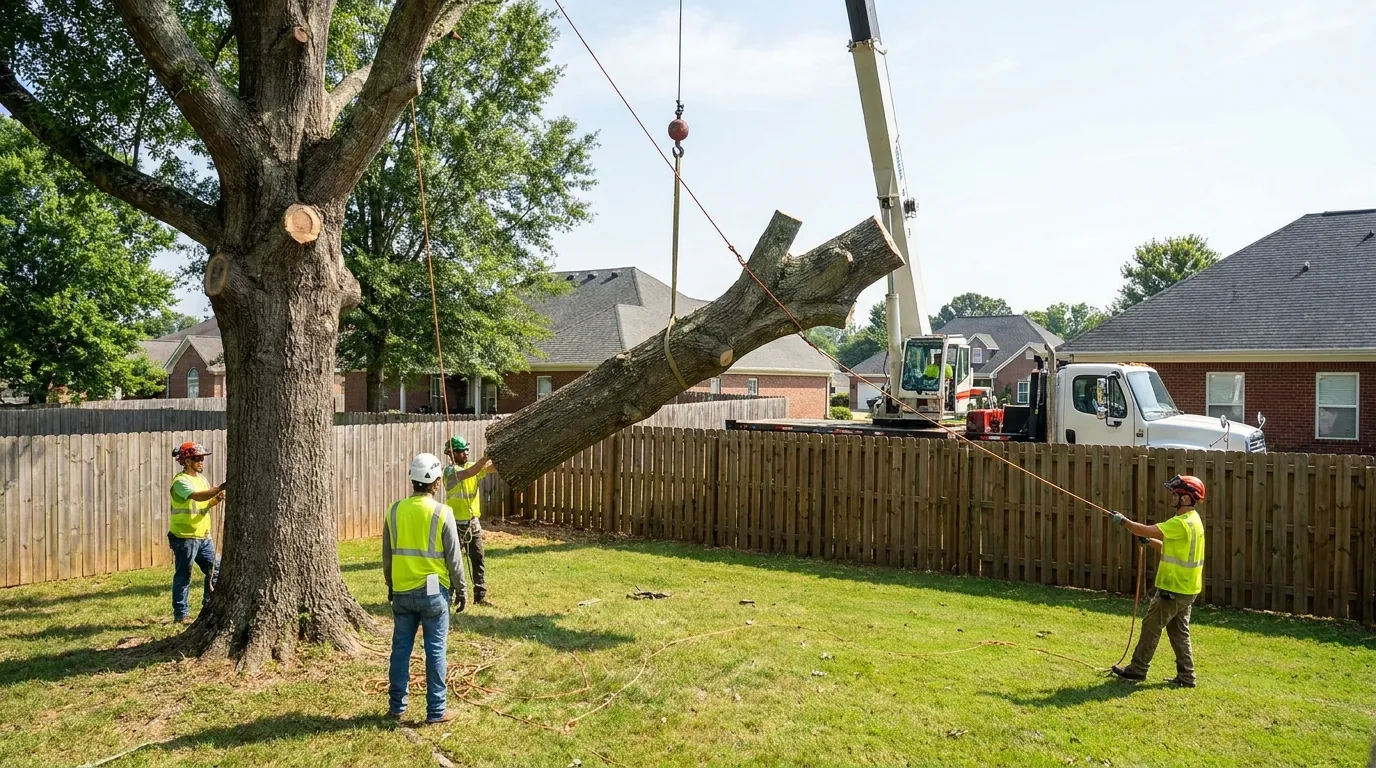
When a tree needs to come down
A tree removal service handles the trees that can no longer stay — the dead oak leaning over a Huntsville rooftop, the storm-split maple hanging over a fence, or the overgrown pine crowding a foundation. Most homeowners search for a tree service near me only after something has already gone wrong: a big limb dropped in a summer thunderstorm, or a trunk that has started to lean after weeks of heavy seasonal rain softened the ground around its roots.
The warning signs are worth knowing before that point. Watch for mushrooms or soft, spongy wood at the base, which points to root or trunk rot. Look for a lean that has appeared or worsened recently, cracks running down the trunk, large dead limbs with no leaves in summer, and soil heaving up on one side of the base. In our humid climate, fungal decay moves quietly through a tree for years before the canopy shows it, so a tree that looks fine from the street can already be structurally unsound.
Removal is not always the answer, and a good crew will tell you when it is not. But when a tree is genuinely a hazard — or simply in the wrong place — taking it down cleanly protects everything around it. If the tree is damaged rather than dead, our tree removal repair work may restore the site once the tree is gone, and if you want to replace it, our tree removal installation service covers planting.
What the work involves
Every removal is planned around the tree, the drop zone, and what surrounds it. A typical residential removal moves through these stages.
-
On-site assessment
We walk the tree, check lean and root health, and identify targets — house, fence, shed, driveway, and overhead lines. This decides whether the tree can be felled whole or has to be dismantled piece by piece.
-
Setting up the drop zone
We clear and protect the landing area, plan rigging points, and account for the soft, saturated ground that red clay becomes after rain. Footing and equipment placement matter as much as the cuts.
-
Sectional dismantling or felling
In tight Huntsville lots, most large trees come down in controlled sections, lowered on ropes rather than dropped. Open lots may allow a directional fell. Either way the goal is control, not speed.
-
Cleanup and debris handling
Limbs are chipped, logs are cut to manageable lengths, and the site is raked. We can leave firewood-length rounds or haul everything off, depending on what you want.
-
Stump decision
Once the tree is down you decide whether to grind the stump, which we handle as part of our broader work, restoring the ground afterward.
How Huntsville conditions change the job
The red clay soil that covers most of the Tennessee Valley behaves very differently from sandy ground. When it is dry it sets hard as brick; after our heavy seasonal rains it turns slick and holds water at the surface. That matters for removal in two ways. First, saturated clay loses its grip on shallow root plates, which is why healthy-looking trees blow over in storms — the failure is in the soil, not the trunk. Second, wet clay makes for treacherous footing and can rut under equipment, so timing and ground protection are part of every plan.
Humidity is the other local factor. Our long, warm, wet summers feed the fungi that rot heartwood and roots, so decay is common in older hardwoods around Huntsville and the neighboring towns. A crew that understands this looks past the leaves to the base and the union points where limbs meet the trunk, because that is where local trees most often fail. Ice is rare here but not unheard of, and the occasional winter storm can overload already-weakened limbs.
All of this shapes when and how a tree comes down. A borderline tree that would be left alone in a dry climate is often worth removing here before the next wet season loads its roots. We serve homeowners across the area — see our work in Madison and Meridianville for how conditions vary from lot to lot.
Have a tree you're worried about?
Tell us what you're seeing — a lean, a dead crown, a limb over the house — and we'll assess it and lay out your options.
Serving Huntsville, Madison, Meridianville, Moores Mill, Athens, New Market, and Redstone Arsenal.
Frequently asked questions
How do I know if a tree really needs to be removed?
Clear signs include a large dead crown, a recent or worsening lean, deep trunk cracks, and soft or fungus-covered wood at the base. In our humid climate, root and trunk decay is common and often hidden, so an on-site assessment is the only reliable way to judge a tree's real condition.
Can you remove a tree that's close to my house or power lines?
Yes. On tight Huntsville lots that is the norm rather than the exception. Trees near structures or lines are dismantled in sections and lowered with ropes rather than felled whole, so nothing lands where it shouldn't.
Is it better to remove a tree in a certain season?
Removals can be done year-round, but dry ground gives better footing and less rutting on red clay. If a tree is hazardous, it should not wait for the season — a wet spring can load weak roots and cause the failure you were trying to prevent.
What happens to the wood and debris?
Limbs are chipped and logs are cut down to manageable size. We can leave firewood-length rounds on site or haul everything away, and we clean up the work area before we leave.